Platform support: ESP’s HLS flows currently target AMD/Xilinx FPGA technology mappings and are not supported by the Intel/Altera DE10-Pro SX flow. Use an RTL or Third-Party accelerator on that board.
Tutorial video:
Note: The video was not recorded with the current ESP release. Use the written guide for the updated ESP integration paths and read its external hls4ml version notice before attempting source generation.
What you will learn
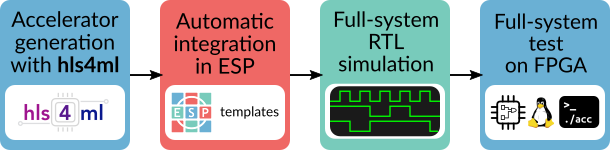
- Integrate in ESP an accelerator designed in Keras/PyTorch/ONNX and generated with hls4ml
- Generate the accelerator with hls4ml
- Run an ESP interactive script to integrate the accelerator into ESP and to generate the Linux device driver and multiple test applications
- Instantiate the new accelerator into an ESP SoC and test the full system with RTL simulation and on FPGA
What you will need
- Prerequisites
- Equipment
- One of the supported FPGA boards (see homepage)
- (optional) An internet router
- (optional) Prebuilt material
What you can read
ESP4ML: Platform-Based Design of Systems-on-Chip for Embedded Machine Learning
Davide Giri, Kuan-lin Chiu, Giuseppe Di Guglielmo, Paolo Mantovani, Luca P. Carloni
In Proceedings of the Design, Automation and Test in Europe Conference (DATE), 2020
What you can contribute
The ESP team welcomes external contributions and collaborations on a variety of topics including but not limited to:
-
Accelerator designs for a wide range of application domains
-
Support for more HLS tools
-
Support for accelerator design flows from domain-specific languages (DSL).
-
Power estimation flow
Check out our contributing guidelines.